


About RE-HOME
How can Europe make better use of existing buildings to address the housing crisis?
This is the question at the heart of LIFE RE-HOME (Reuse and Enable Housing Opportunities through Municipal Experimentation). Funded under the EU’s LIFE Programme for the Environment and Climate Action, the project demonstrates how sufficiency and adaptability can help transform vacant and underused buildings into affordable, sustainable and inclusive homes – while reducing the need for new construction and lowering the environmental impact of the built environment.
Working across four pilot municipalities – Chalandri (Greece), Mechelen (Belgium), La Rochelle (France) and Hrastnik (Slovenia) – the project tests different pathways towards affordable housing through the reuse and adaptation of existing buildings.
The challenge
Across Europe, millions of homes remain empty or underused, while municipalities face rising housing needs, affordability crises and increasing pressure to safeguard land and local ecosystems.
Although unused buildings could help address this housing paradox, bringing them back into use is often complex. Local authorities face legal, regulatory and governance barriers, compounded by a lack of shared definitions, reliable data on vacancy and underuse, and integrated approaches to housing. Planning, housing, climate and social policies are often addressed separately, limiting municipalities’ ability to identify opportunities and make better use of their existing building stock.
Addressing these challenges requires more than individual building projects. It calls for better local diagnostics, collaboration across municipal departments, community participation, adaptable methods and policy frameworks that enable the wider adoption of sufficiency and adaptability principles in housing.
Project goals
Together with local partners, the four pilots test different models, aiming to:
- make better use of existing housing stock to create affordable, sustainable and inclusive homes;
- lower the environmental footprint of the built environment and curb urban sprawl;
- tackle legal, regulatory, governance and data barriers to repurposing; and
- bridge the gap between local policies on housing, planning, climate and social issues.
Based on each pilot’s local context and needs, the approaches range from adaptive reuse and home-sharing to biodiversity-friendly densification and the reactivation of vacant municipal housing for vulnerable groups.
These pilot experiences are the starting point for a wider ambition: helping municipalities across Europe put sufficiency and adaptability into practice. Building on the pilots, RE-HOME will:
- co-design four place-based transformation strategies in the pilot cities;
- implement four pilot interventions demonstrating different approaches to affordable housing through the adaptive reuse of existing buildings;
- support ten housing micro-experiments in additional municipalities to test and replicate the RE-HOME methodology;
- strengthen the capacity of municipalities and local stakeholders through training, mentoring, and peer learning;
- produce a transferable methodology and toolkit for housing transformation; and
- propose policy recommendations to address barriers to the wider adoption of sufficiency and adaptability.
Approaches / Methods
Mapping and diagnostics
Identifying vacant and underused buildings through spatial mapping, community diagnostics and creative documentation
Place-based transformation strategies
Co-designing long-term housing strategies with municipalities and local stakeholders
Pilot demonstrations
Testing adaptive reuse, home-sharing, gentle urban densification and the reactivation of municipal housing across four different local contexts
Learning and replication
Supporting municipalities through workshops, training, and peer learning, a transferable toolkit and ten additional housing micro-experiments
Policy innovation
Developing recommendations that help municipalities overcome legal, financial and governance barriers to the reuse of existing buildings
Cooperative City’s role in RE-HOME
Cooperative City leads the co-design of the four place-based transformation strategies, working with municipalities, local stakeholders and communities to turn vacant and underused buildings into inclusive, affordable housing.
Cooperative City also leads RE-HOME’s communication and dissemination activities, and coordinates creative documentation and storytelling. Together with local artists and cultural practitioners, it helps capture the emotional, cultural and narrative dimensions of vacant and underused spaces and their potential transformation. It also contributes to capacity building, peer learning and knowledge sharing, helping bring RE-HOME’s lessons to municipalities across Europe.
About the pilot cities
RE-HOME develops and tests its approach in four pilot contexts, each responding to a different housing challenge while demonstrating how existing buildings and spaces can become affordable, sustainable and inclusive homes.
Chalandri, Greece
Adaptive reuse of historic refugee housing
The Chalandri pilot focuses on the adaptive reuse of a historic house built in the 1930s to accommodate Asia Minor refugees. By transforming this building into affordable housing, the pilot demonstrates how cultural heritage can become part of the solution to today’s housing challenges, strengthening community identity and preserving local history.
Mechelen, Belgium
Home-sharing and co-living in oversized family homes
Many homes in Mechelen were built for larger families and are now underused. The pilot explores home-sharing and co-living solutions that make better use of existing housing and meet changing local needs, while creating affordable homes and supporting intergenerational living.
La Rochelle, France
Gentle urban densification and biodiversity-friendly gardens
La Rochelle demonstrates how gentle urban densification can be a socially acceptable alternative to urban sprawl for increasing housing supply. By combining plot subdivision with biodiversity-friendly gardens, the pilot creates new housing opportunities while improving climate resilience and supporting local biodiversity.
Hrastnik, Slovenia
Reactivating vacant municipal housing for vulnerable groups
Hrastnik, a former industrial town, reactivates vacant municipal housing to provide safe and affordable homes for vulnerable groups. The pilot combines housing transformation with neighbourhood regeneration and participatory public space improvements.
Project partners
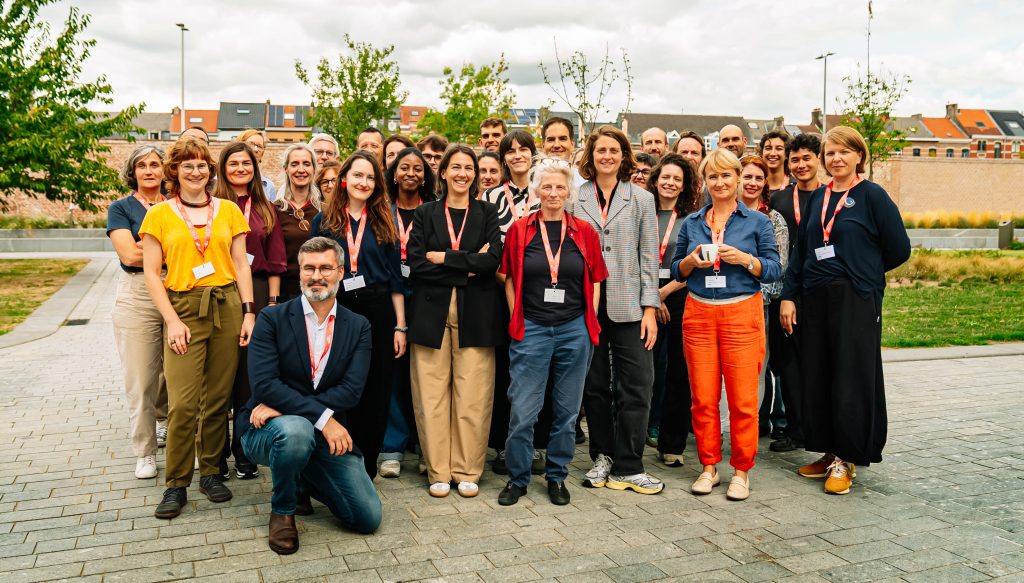
RE-HOME brings together municipalities, research organisations, urban practitioners, European networks and civil society organisations to develop new approaches to affordable housing through the reuse of existing buildings.
Project coordinator
- Energy Cities coordinates the project, leading its overall management, learning activities and the long-term uptake of project results across Europe.
European partners
- Cooperative City – co-design, creative documentation, communication and dissemination
- FEANTSA – housing policy, advocacy and European dissemination
- Urbanex – pilot demonstrations, monitoring and evaluation
- Urbana – mapping, inclusive design and participatory processes
- Vraiment Vraiment – diagnostic tools, mapping and spatial analysis
- Villes Vivantes – housing densification and urban planning
Pilot municipalities and local partners
RE-HOME is implemented in four pilot municipalities, each working with local organisations that bring technical and research expertise, community engagement and implementation support:
Greece
Belgium
- City of Mechelen
- Samenhuizen NGO
- LabLand
France
- City of La Rochelle
- La Rochelle Urban Community
Slovenia
- Municipality of Hrastnik
- Regional Development Agency Zasavje
- Institute for Innovation and Development of University of Ljubljana
Together, the consortium combines expertise in housing, urban regeneration, spatial planning, community participation and co-design methodologies, policy development, and communication to create practical solutions that can be replicated by municipalities across Europe.
