


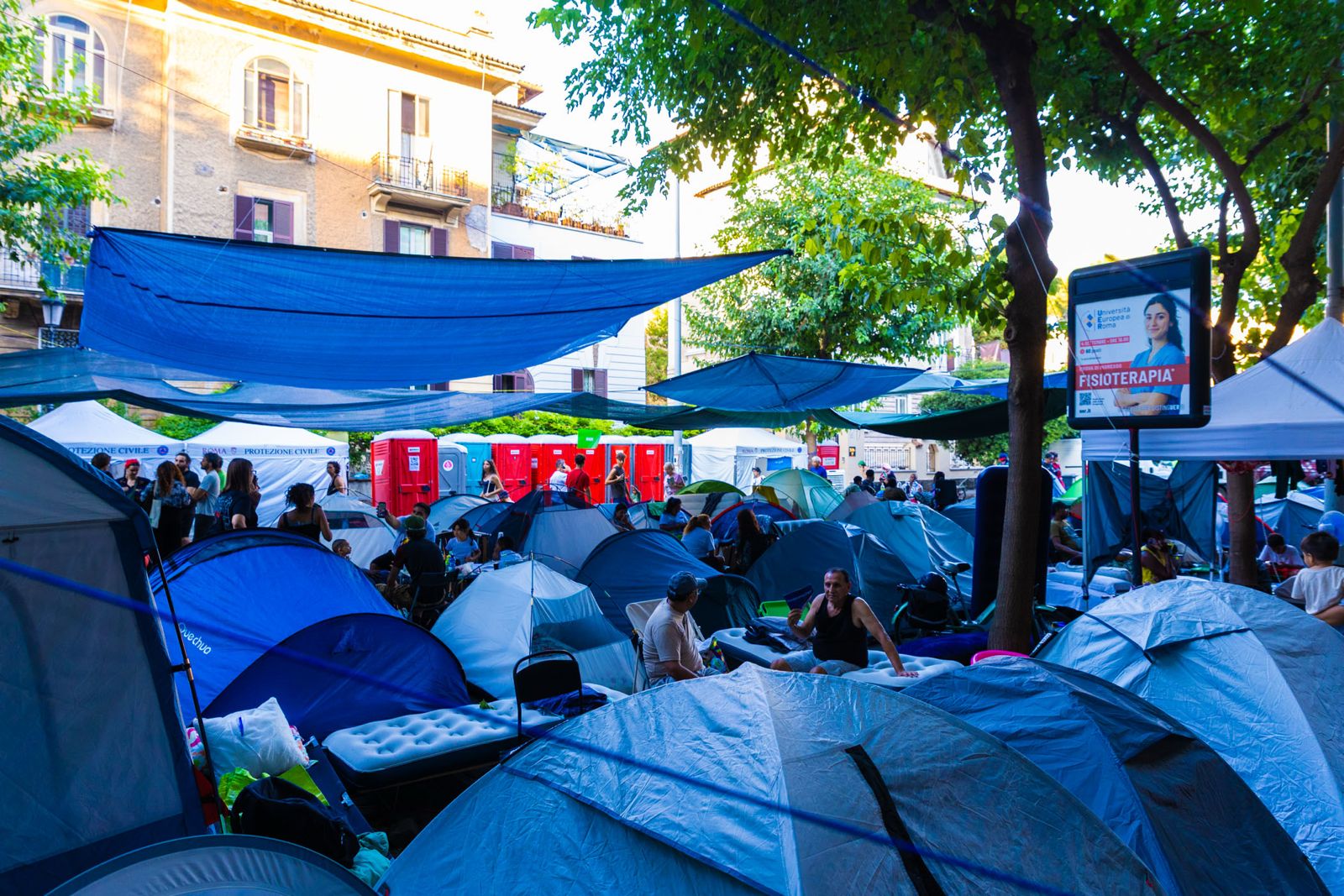
The Spin Time Labs occupied housing and community hub in Rome was recently evicted after 13 years of squatting and value creation in the city. This building hosted over 400 people, of whom 100 were children, from 27 different nationalities which co-existed in an ex-office building turned into housing, which also hosted nineteen social and cultural initiatives, such as a youth-run magazine, a carpentry shop, a food distribution network and support services for people crossing the Mediterranean. As Cooperative City we have been hosted on many occasions in their space and have interviewed the inhabitant and unionist Aurora Iacob to better understand the Spin Time Labs experience and the broader local context.
| Call to action If you would like to support Spin Time, consider donating to their Go Fund Me. If you are in Rome, please consider joining the national demonstration on Saturday 19th September and the Assembly on Sunday 20th September. |
For us at Cooperative City the eviction of Spin Time Labs on 29 July 2026, after the building was declared unsafe after a fire, came as shocking news. Over the past thirteen years we were hosted on many occasions by this community which occupied the abandoned former National Welfare Institute for Employees of Public Authorities in the Esquilino district of Rome. community to showcase a different way to develop services, provide housing and ultimately build a city for all. Ten years ago we joined with our project funded by the European programme URBACT, [1] through which we were looking into community-based temporary reuse of buildings together with the Municipality of Rome, Bremen in Germany and Alba Iulia in Romania. Then, just last year we held a public debate on community engagement in public space, together with the Dutch, Norwegian, Hungarian and Austrian partnership of our DUT European project, in the community spaces of the editorial board of Scomodo, in the ground floor of Spin Time Labs. Furthermore, we joined so many other occasions such as debates, events and community gatherings taking place in this building.
Because we know this community hub rather well, and especially we are closely monitoring the strong urban speculation and securitarian approaches that are taking place in the Italian capital, this eviction came to us as no surprise. In fact, the eviction itself was handled as a police matter, not a housing one. Armed police sealed the building’s gates that same night, with no emergency housing or relocation plan offered to the roughly 400 people left on the sidewalk, who had been living in the occupied space, made up of 27 different nationalities, including more than 100 children.
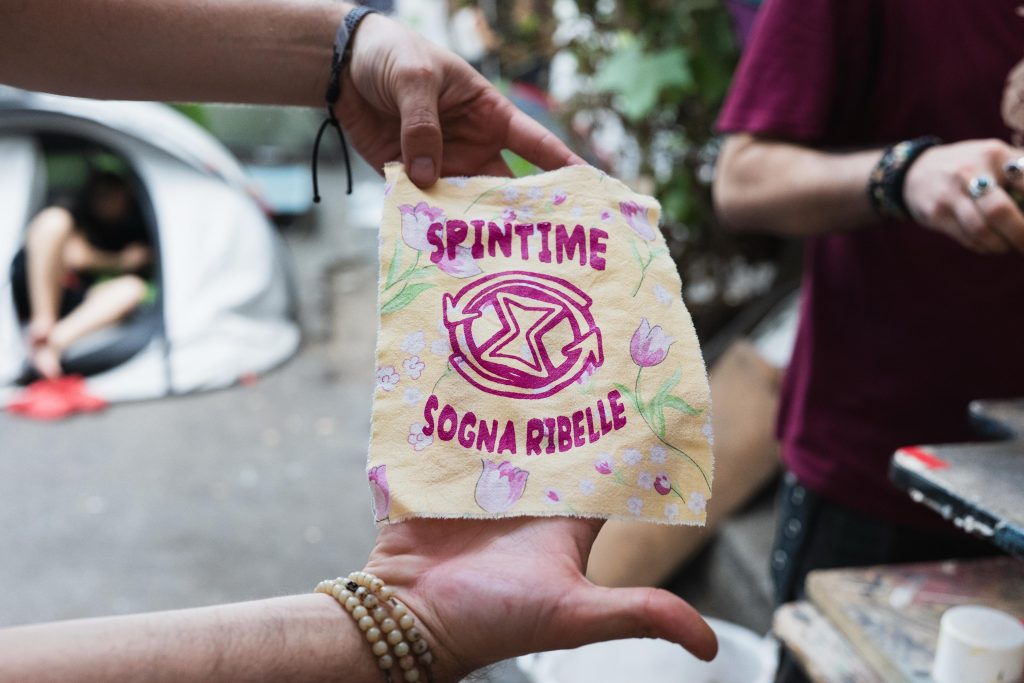
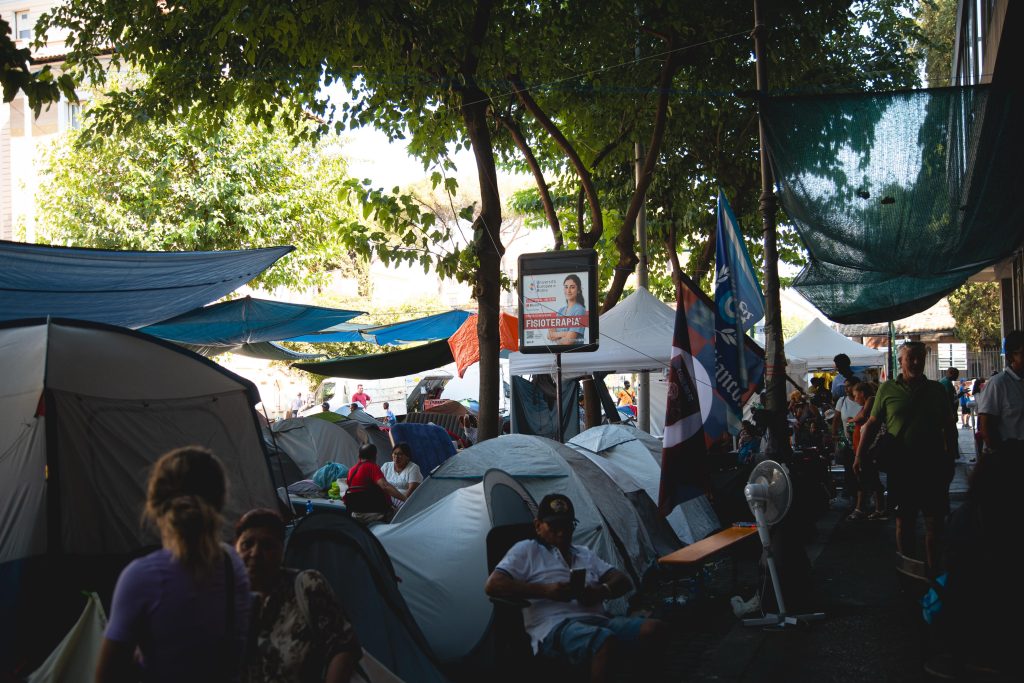
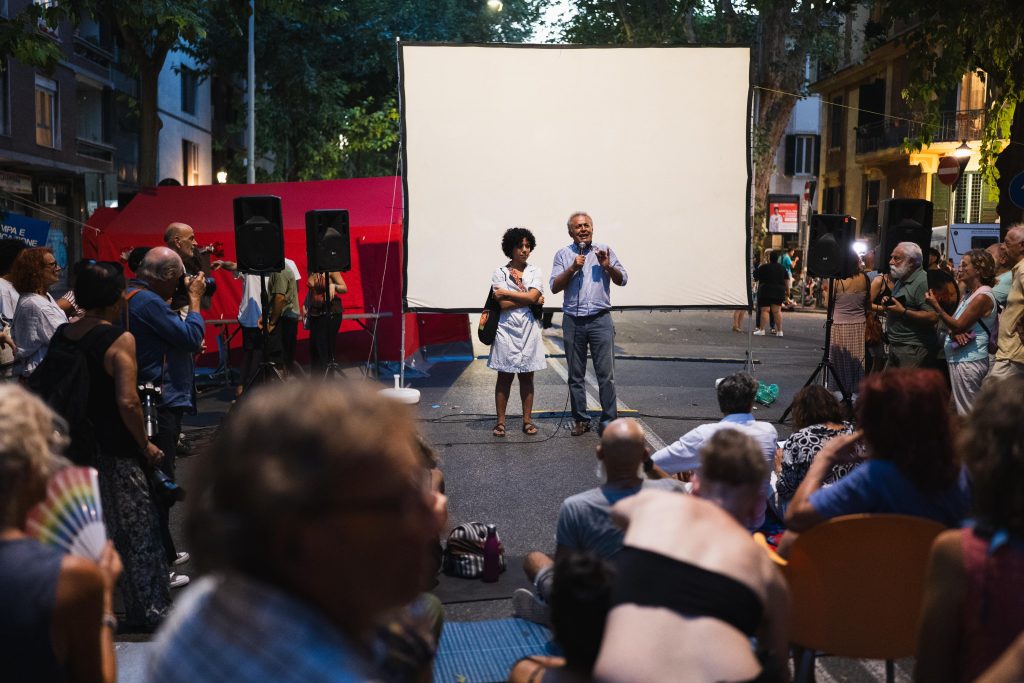
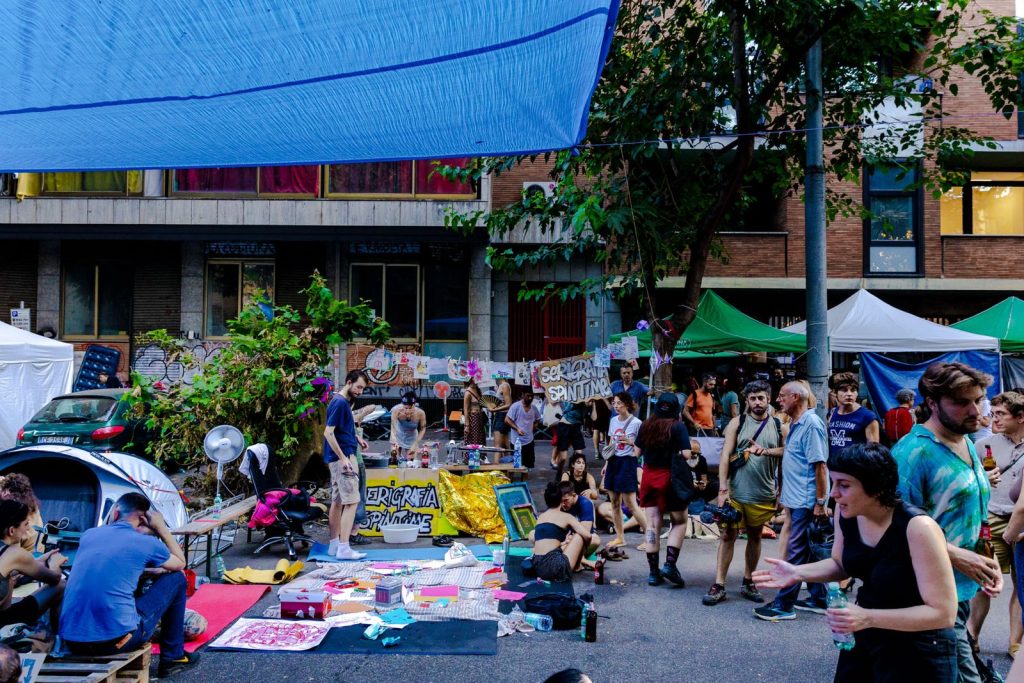
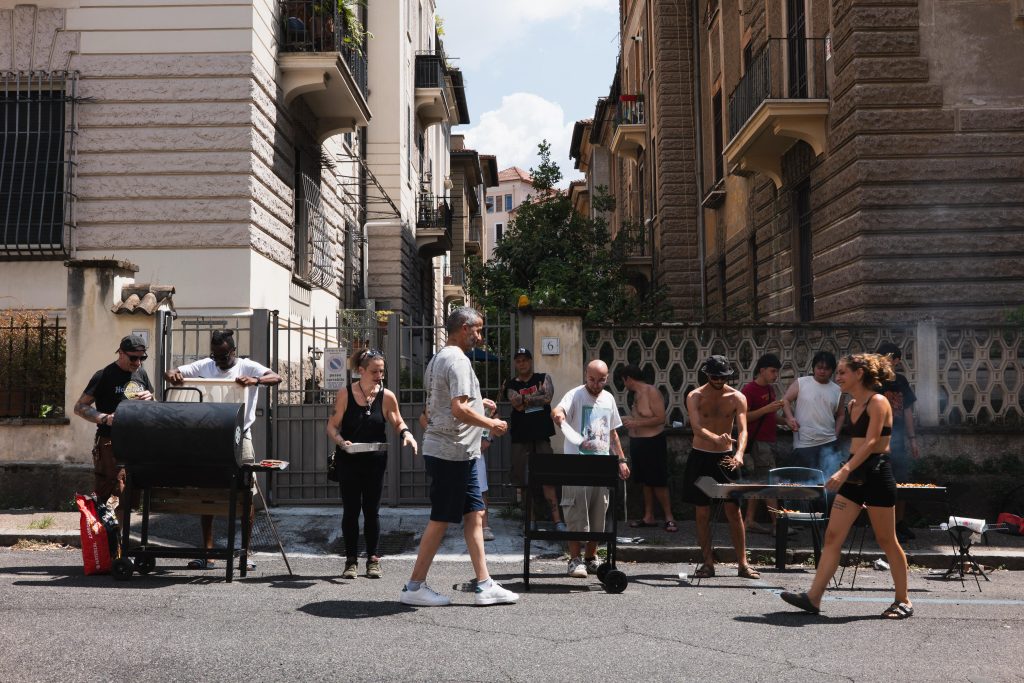
An excellent example of grassroots urban regeneration, Spin Time Labs has transformed the abandoned building into a warm, welcoming, and innovative fixture in Rome. Within the seven-story building, Spin Time hosts nineteen social and cultural initiatives. These range from a youth-run magazine named Scomodo, and carpentry shop to a food distribution network providing regular food to 230 families and policy workshop and fundraising apparatus for people crossing the Mediterranean. Since the eviction, the members of Spin Time Labs have camped outside of their building or found alternative places to call home. The street has been transformed by both the tents and an atmosphere of solidarity through kitchens, music, speeches and presentations.
The building occupied by Spin Time Labs is part of Italy’s FIP state property portfolio and is managed by the private investment firm Investire SGR, which the City Council of Rome has been negotiating with over the past months to find an agreement but who ultimately rejected the City’s proposal to buy the building. In fact, the City Administration formally proposed a two-part deal to Investire Sgr: purchasing the building at a value to be assessed by the state property agency, and, in the meantime, signing a “bridge agreement” that would allow the city to immediately retake possession and gradually resettle families, prioritising school-age children to preserve continuity in their education. Investire rejected the plan. For Spin Time’s residents, the Municipality of Rome has proposed emergency accommodation for up to 60 days while working towards accessing public housing. But the discussion on the acquisition of the building dates back to 2022, when a social impact assessment was carried out by Open Impact, which highlighted an economic and social return of roughly double the value generated, which led to institutional efforts by the municipality to acquire the property that ultimately led to no agreement and left the Spin Time Labs community in the same conditions despite the recognition of public value.
This experience of Spin Time Labs is not only a Roman case study for right to housing, but can be framed within a broader European context which raises great conflict around the housing issue and has led to Affordable Housing Act, an initiative which aims at establishing a common EU framework to give local and national authorities legal certainty when implementing measures, such as regulating short-term rentals and tackling speculative property pressures, to safeguard housing affordability and availability. In fact, Spin Time Labs became a home for a growing number of people who were unable to afford rising private market rents, experiencing unstable home environments, or navigating long wait lists for public housing. For this reason, evictions in Rome can generate political pressure that shapes subsequent housing interventions. One motivation for municipal interventions in affordable housing is argued to be avoiding public backlash following aggressive responses to squatting (Gillespie, 2026). At Spin Time, that dynamic is now playing out in real time, as many residents have spent the past 13 years on public housing waiting lists.
Spin Time Labs should be understood as more than just a housing occupation or a squat, as it was a place of habitation, imbued with life and social reproduction. At this very moment, the residents of Spin Time are experiencing an acute emergency. However, broadening our scope, we should consider understanding the housing situation in Rome as a ‘habitability crisis’ rather than a housing emergency or emergenza abitativa (Grazioli, 2026). In doing so, this allows us to re-centre the people and their experiences as well as relinquishing the temporality of an ’emergency’. Similarly, an eviction is often depicted with a distinct temporal sentiment. Someone is housed and then is removed, becoming unhoused. If members of Spin Time are unable to return, their social, emotional, and geographical lives in Rome are fundamentally changed. This was, in other words, a political act rather than a purely economic one, and one that should be continuously analysed and contested by political movements, the municipality, and the broader international media currently reporting on Spin Time.
To better understand the Spin Time Labs experience and the broader Roman context, we interviewed Aurora Iacob, a resident of Spin Time Labs for the past six years and a trade unionist at CGIL Fillea in Rome, in the summer of 2026, shortly after the eviction.
What does Spin Time mean to the neighborhood and the city of Rome?
Spin Time is interesting because, beyond being a housing occupation that responds materially to a housing crisis suffocating our city, it offers an answer to a politics that has failed to take care of people. Spin Time has responded to this housing crisis for 13 years, but its strength has led it to become one of the most representative liberated spaces in the world.
Spin Time is no longer just the dispute of Spin Time. It is the dispute of a city that where those who can’t afford rent are not left behind. If you don’t have a meeting space, Spin Time offers you one. It offers a network of solidarity, an extensive network of associations, a place to work, a barber, a theatre, culture, a tavern, and so much more.
Spin Time collaborated with Open Impact on a study led by Luigi Corvo, which found that the space generates an estimated €71.55 million in social value against an estimated cost of €36.7 million for purchase, energy retrofit, maintenance, and community management. This means a return multiplier of 1.95, or almost €2 in social value for every €1 invested. In this difficult moment, we want to convey the fact that Spin Time is a positive force. Economically, it returns money to the local area, while a broader network often provides services that would otherwise have to be paid for. Beyond this, there is a cultural and human heritage here that should always be valued.
The eviction came right on the heels of that fire. How has that timing felt to you and the rest of the community?
We are trying to respond positively to the cowardice of those who decided to evict a community while a fire in their home was still unfolding. We never expected them to use these methods, to seize the opportunity created by the fire to execute the eviction order. I never thought politics could stoop so low as to use a tragedy as an excuse to throw children out of their homes.
It’s not easy, and with each passing day, we are more and more physically and psychologically tired due to the stress and uncertainty of what tomorrow may bring.
How have you and the other residents been coping in the weeks since?
There is great resilience amongst residents. The solidarity that came to us from all of Rome fills us with energy and makes us feel that we are not alone. This is not a dispute that only concerns us who lost our homes; it concerns everyone who could lose their homes one day, or those who are on the street and do not have a physical home.
Even in this tragedy, there have been some positives. There is a very deep sense of community, mutual aid and solidarity. This has particularly impressed me because I have been privileged to always have a roof over my head. I never imagined that such a strong sense of community could emerge in the face of such great misfortune.
The negotiations between the City Council and building owner Investire Sgr collapsed after several rounds. What does that say to you about the balance of power here?
We are facing a democratic problem. In my opinion, the Spin Time dispute concerns everyone because a large private investment fund has been able to say no to proposals backed by the Prefect of Rome, the Municipality, and the Vicar of Rome, the senior Church official who administers the diocese on the Pope’s behalf. This shows how deeply embedded these private funds are within the city and how much arrogance comes from the political protection they enjoy. These private funds have the legitimacy of the right wing behind them, which makes them feel immune and untouchable. For this reason we made an appeal to the centre-left forces, to the other mayors, so as not to leave Rome’s mayor, Roberto Gualtieri, alone.
Why do you believe this goes beyond a straightforward commercial decision?
It does not make sense purely on commercial terms, as the building is due to be returned to the Public Real Estate Fund (FIP) by 2027 regardless, so sooner or later it has to be sold. That is why we cannot help but think there was interference by politics, by the government, by someone like the Minister of Interior Piantedosi, who, as Rome’s former prefect, knows Spin Time’s history well. Additionally, we know very well the kind of operations they have carried out with other liberated spaces in this city. This fits fully into their plan, and we knew from the start that we would be among the first on the eviction list in Rome. A government whose first act was the so-called anti-rave decree, a law targeting unauthorised gatherings and occupations, which critics saw as targeting informal and squatter communities, tells you something about where its sympathies lie.
What are you asking of Mayor Gualtieri and the city right now?
The battle we are asking Mayor Gualtieri to fight is to secure temporary housing and, ultimately, access to public housing. Obtaining public housing would be a victory for the people who have occupied Spin Time in their struggle for the right to housing.
The priority is the right to a home for these 400 people who, after 13 years of sacrifice, deserve their own home. Those who criticise us for skipping the waiting lists should know that many of these people have been on the waiting lists for 13 years. I want to avoid a war between the poor. That is the priority. Mayor Gualtieri’s administration formally proposed that the city purchase the building at a value to be assessed by the state property agency. In the meantime, a “bridge agreement” would allow the city to retake possession and gradually resettle families, prioritising school-age children to preserve continuity in their education. Investire rejected this plan. The Municipality of Rome has proposed emergency accommodation for up to 60 days while working towards accessing public housing.
This is a political battle that must be fought and won. Otherwise, what tools do we have to protect our citizens, especially the most vulnerable, when those with the biggest wallets have more power than we do?
Spin Time’s situation touches on housing policy well beyond this one building. How do you see it fitting into the national picture?
Spin Time is highlighting a problem that clearly has existed for years. Housing policies have not been widely spoken about, and if we do speak about them, it is related to Meloni’s housing plan which is opening doors to private investment funds. In the city of Rome there is an evident housing emergency and an urgent need to address the social issue of housing. Housing has been a quieter issue in Rome than in national debates. However, now the cards are on the table. We must not stop hammering home the principle that politics is sovereign even with respect to these large owners and powerful landlords.
What would count as a real resolution here, for you?
We think the battle must be won in the case of Spin Time. Buying this building is the most politically, economically, and socially logical option. We will continue to ask that this dispute stays alive. Another central issue is not to disperse the community that we created over these years, to make sure that the occupiers and the social centres continue to coexist. These are in symbiosis, we do not function without each other.
By letting Spin Time fall, you lose a part of the idea that building things from the bottom up, constructing as we say, “another possible world,” is actually possible. We have anxiety about the liberated spaces of our city, because Spin Time was our impregnable fortress, and we do not know what will happen next.
What can people outside Spin Time do to help right now?
On a material level, if someone wants to contribute, they can see on the Spin Time Instagram page what materials are needed. But on a practical level, my advice is simply to come here and try to bring a smile to a person who right now has nothing in their life. Ask them how they are doing. That is the most important thing we can do.
Do not lower your attention. Share, spread, talk about Spin Time. Talk to your grandmother, your uncle, and keep the Spin Time dispute within the political and public debate. Otherwise we risk these people truly being forgotten. This would be a mistake in which the entire city would suffer. If you want to support us, consider donating to our GoFundMe, joining us for our national demonstration on 19 September, and keeping up with our daily engagements on our Instagram.
Sources:
Giuffrida, A. (2026, 5 August). Hundreds camp in Rome heatwave as Meloni government cracks down on squats. The Guardian. https://www.theguardian.com/world/2026/aug/05/hundreds-camp-in-rome-heatwave-as-meloni-government-cracks-down-on-squats
Clough Marinaro, I. (2022). The violence of timings: Eviction in a pandemic. In S.
Pontrandolfo & M. Solimene (Eds.), I Rom e il Covid (pp. 59–83). CISU.
Ciccarelli, R. (2026, 30 June). The heatwave is political: Workers will pay for climate collapse. il manifesto. https://global.ilmanifesto.it/the-heatwave-is-political-workers-will-pay-for-climate-collapse
Gillespie, T., Williams, G., Beier, R., Gosnet, A., Grazioli, M., Purcell, T. F., Shen, J., & Ward, C. (2026). Affordable housing, finance and the state: Towards a global urban comparison. Urban Studies, 0(0). https://doi.org/10.1177/00420980261436336
Il Post. (2026, 7 August). I proprietari del palazzo di Spin Time hanno rifiutato una proposta di acquisto del comune di Roma. https://www.ilpost.it/2026/08/07/spin-time-investire-proposta-comune-rifiuto/
Roma Report. (2026, 10 August). Spin Time, a che punto è la vicenda. https://www.romareport.it/spin-time-a-che-punto-e-la-vicenda/
Grazioli, M. (2026). Beyond the housing emergency: Conceptualizing the habitability crisis
in Rome’s housing squats. In I. C. Marinaro & W. Haynes (Eds.), Living Rome: Space,identity, and the politics of belonging (pp. 65–83). Lever Press. https://doi.org/10.3998/mpub.13082620.
Cacciotti, C. (2026). The Afterlife of Sgomberi in Rome: Political and Affective Frameworks of Evictability in the Lives of Former and Current Squatters In I. C. Marinaro & W. Haynes (Eds.), Living Rome: Space, identity, and the politics of belonging (pp. 85–105). Lever Press. https://doi.org/10.3998/mpub.13082620.
Corvo, L. (2026, 13 August). Spin Time: la crisi come occasione. Costruiamo il modello che verrà. il manifesto. https://ilmanifesto.it/spin-time-la-crisi-come-occasione-costruiamo-il-modello-che-verra
Barry, C. (2022, 2 November). Italy’s right-wing government slammed for anti-rave decree. AP News. https://apnews.com/article/europe-rome-italy-giorgia-meloni-5b219c5fabf34baf0eabffd2c5564d3c
Discover other articles on occupied spaces or housing
