What is Co-PED?
Co-PED (Cooperative Positive Energy Districts) is a European research and innovation project funded by the Driving Urban Transitions (DUT) Partnership. The project brings together partners from seven countries to develop innovative financial, organisational and governance models for decentralised, cooperative energy communities. Its core premise is that Social and Cultural Centres (SCCs) can play a strategic role in the transition towards Positive Energy Districts (PEDs), acting as anchors that connect residents, local institutions and small businesses around shared renewable energy systems.
Co-PED addresses structural challenges intensified by the energy crisis: rising costs, unequal access to renewable energy, fragmented ownership structures and limited citizen participation in energy systems. The project seeks to strengthen collaboration between energy producers and consumers, encourage democratic decision-making, and link social, economic and technological innovation. By organising energy communities around cultural venues and neighbourhood networks, Co-PED explores how local renewable production, collective governance and fair distribution models can be combined in practice.
In Hungary, Co-PED is implemented in Bartók Quarter (Újbuda, Budapest) and at Bakelit (Southeast Budapest). Both sites test how community-based renewable energy models can function under Hungarian regulatory, spatial and ownership conditions.
Urban Living Lab Bartók Quarter – Újbuda, Budapest
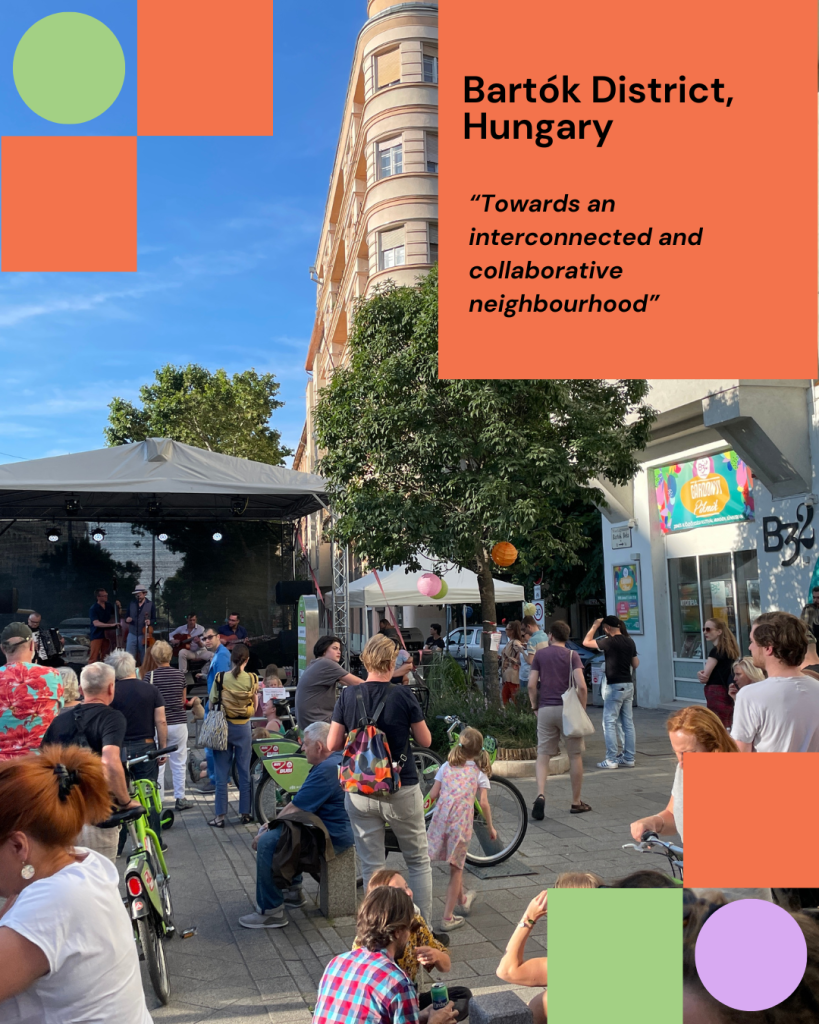
Bartók Quarter is a well-established cultural district that brings together cultural initiatives, creative producers, NGOs, universities and public institutions. The area is characterised by dense residential blocks with ground-floor cafés, galleries, community spaces and small businesses, creating strong potential for neighbourhood-level cooperation.
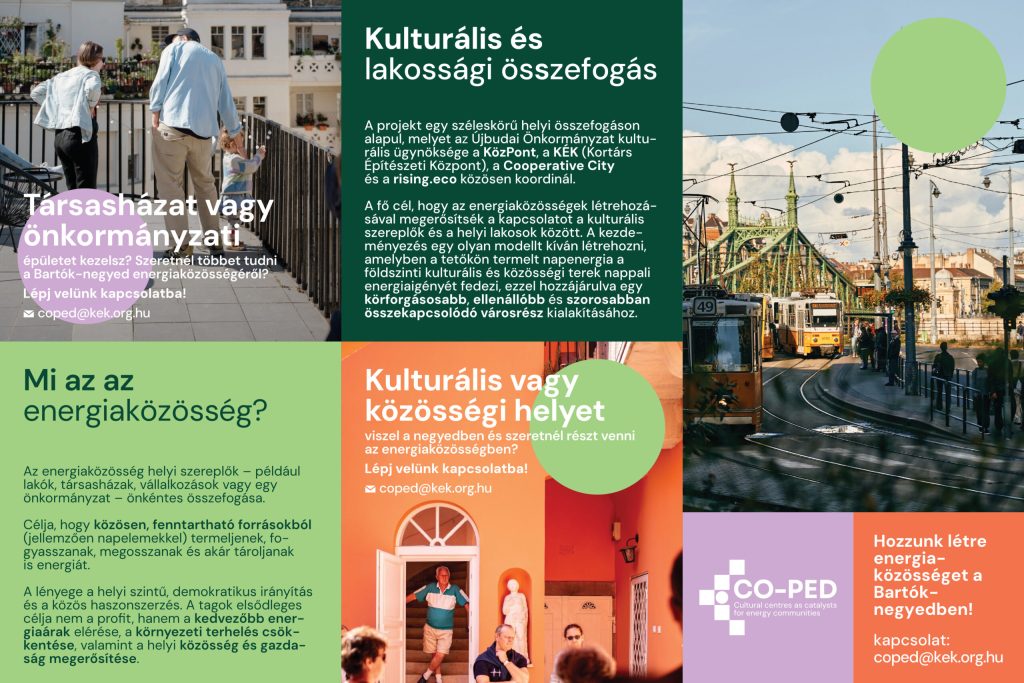
Within Co-PED, the focus in Bartók Quarter is on exploring how condominium rooftops can generate solar energy that supports not only residents but also the cultural and commercial spaces operating at street level. The concept links the solar capacities of residential buildings with the daytime energy demand and organisational capacities of ground-floor actors.
The aim is to develop a viable neighbourhood-scale energy community model that:
- enables shared renewable energy production in dense urban fabric,
- establishes fair and transparent allocation mechanisms between households and local venues,
- supports long-term cooperation between residents and cultural actors, and
- strengthens the district’s economic resilience and environmental performance.
By embedding energy communities within the existing cultural ecosystem of the district, the project tests how local identity, trust networks and community infrastructure can support energy transition processes.
Urban Living Lab Bakelit – Southeast Budapest
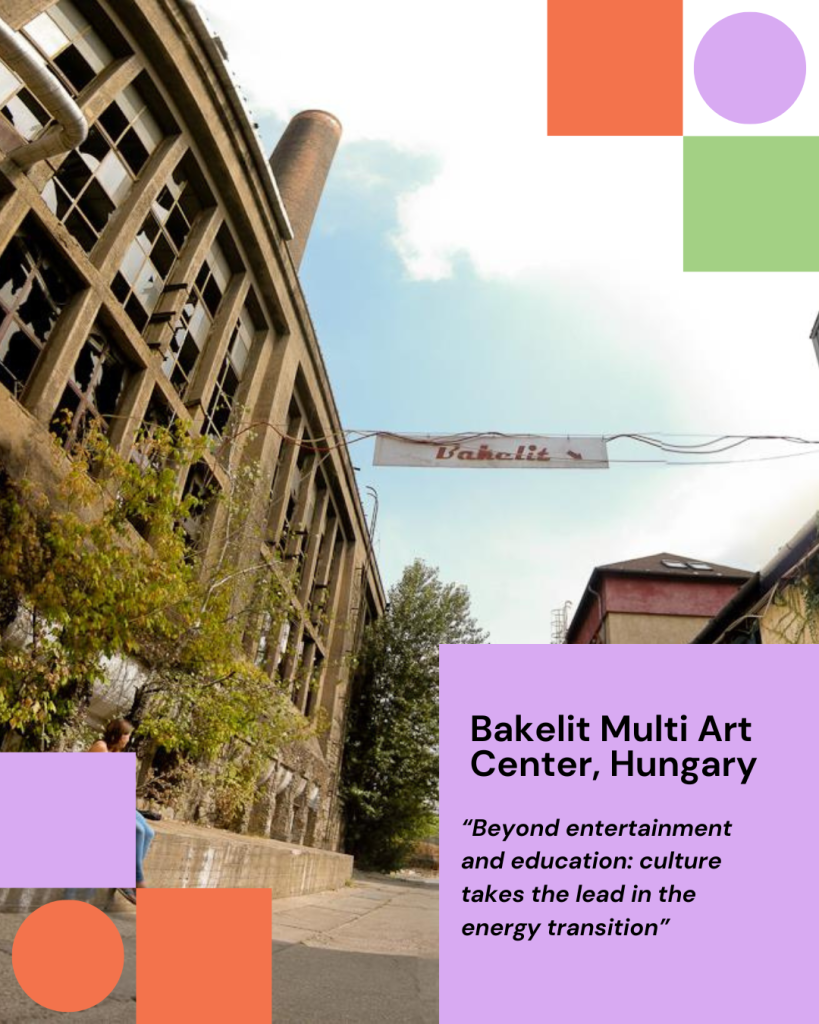
Bakelit is a cultural venue operating in a former manufacturing complex located in a large post-industrial area of Southeast Budapest. The site is marked by fragmented ownership, underused industrial buildings and the absence of a coordinated development vision.
In response to rising energy costs and structural vulnerabilities, Bakelit has initiated steps towards a more self-sufficient energy production and consumption model. Within Co-PED, the focus is on exploring how an energy community can be developed in this complex environment, using the cultural venue as a local anchor.
The Bakelit context differs significantly from Bartók Quarter: instead of a dense mixed-use urban district, it operates in a spatially dispersed, industrial setting. Here, Co-PED examines how cooperation can be built among neighbouring property owners and stakeholders to establish a coordinated renewable energy strategy. The objective is to lay the groundwork for a shared energy model that increases local energy autonomy, supports the long-term sustainability of cultural activities, and creates a framework for collective governance in an otherwise fragmented area.
Through Bartók Quarter and Bakelit, Co-PED in Hungary investigates two distinct urban conditions — a dense cultural district and a post-industrial site — to understand how cooperative energy communities can be structured, governed and sustained in practice.
Visit Bartók District Urban Living Lab’s Hungarian language page
This page features an FAQ including topics on the definition of energy communities, the role of local cultural spaces and community offices, participation of residents and building managers, shared renewable energy use, and ways to join or support Co-PED initiatives.
Events
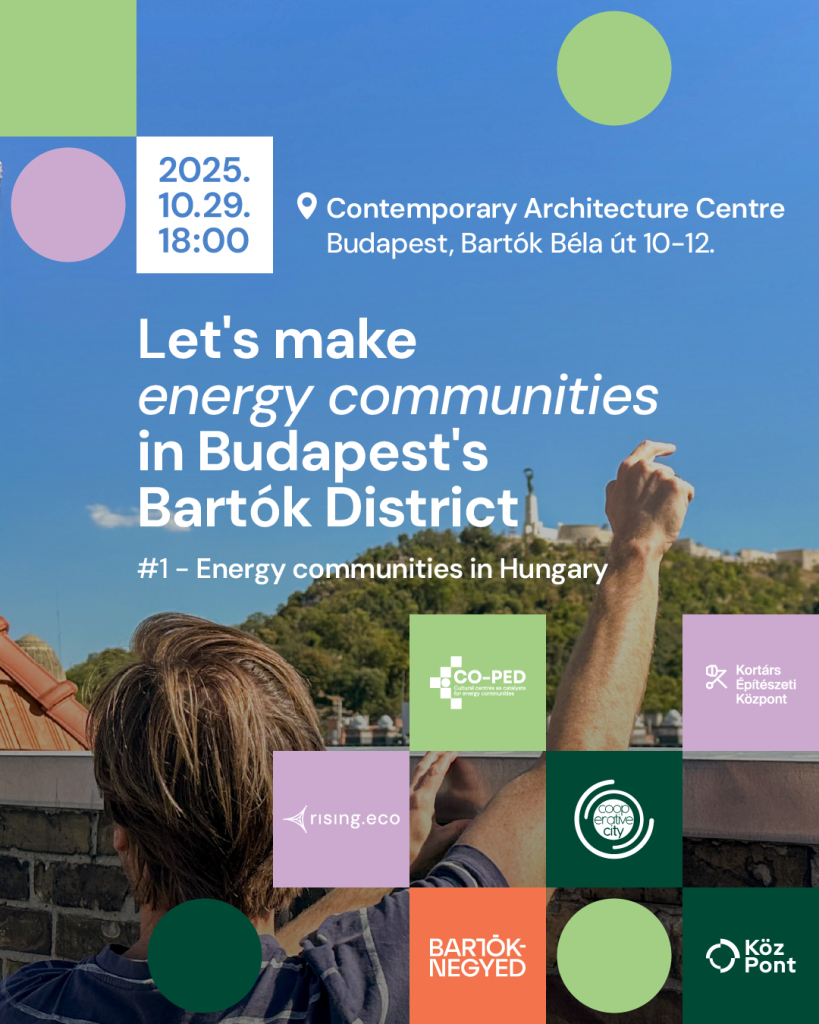
What if the condominium buildings of the Bartók District could power not only their residents, but also the cafés, cultural hubs, community spaces and small businesses on their ground floors — using solar energy produced directly on their rooftops? This is the core mission of the Bartók District as one of the Driving Urban Transitions Partnership (DUT) funded Co-PED project’s eight European urban living labs: to test how a neighbourhood-level energy community can work in a dense city, linking homes with the vibrant cultural and community life at street level.
Our first community meeting, held on 29 October at KÉK – Contemporary Architecture Centre, opened this conversation to residents, building representatives and local actors who want to shape the district’s energy future.
Partners